Heat Waves & High UV: What Your Skin is Actually Up Against This Summer
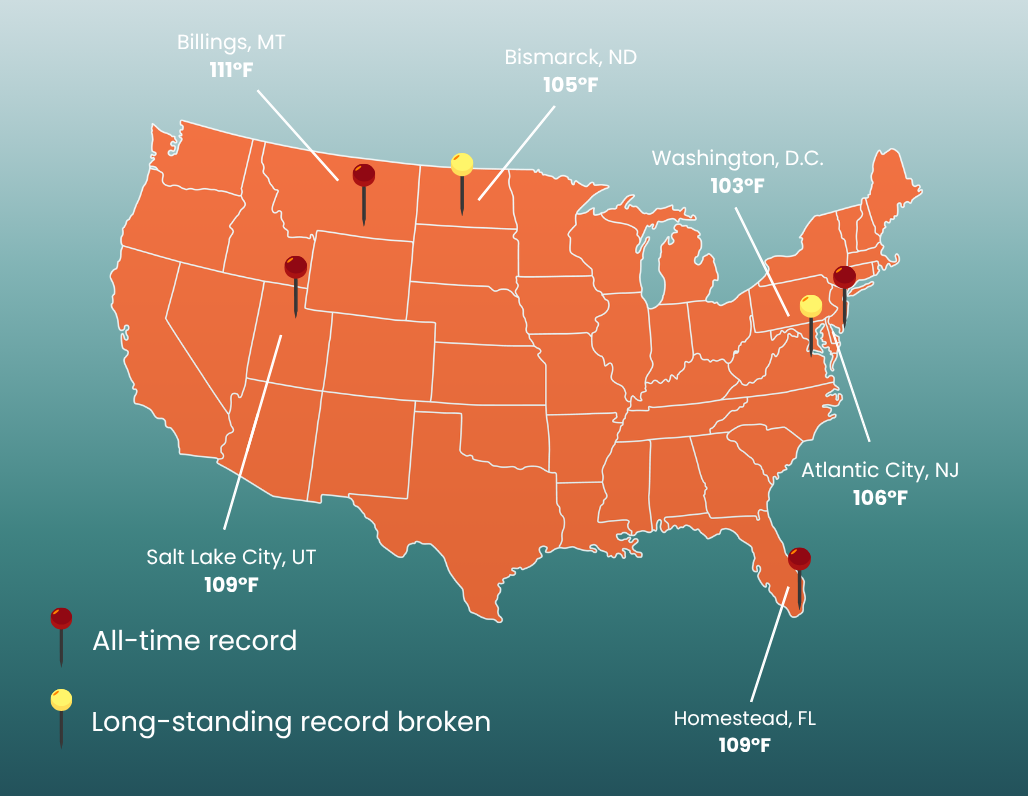
It’s been a brutal summer almost everywhere.
2026 has already delivered back-to-back heat domes across the country – record highs in Salt Lake City, Phoenix, and Billings, heat indexes pushing past 110°F in some regions, and forecasters watching for a third wave before the season’s out.
Most of the conversation has understandably been about staying cool. Almost none of it has been about what all that time outside is doing to your skin.
Here’s the part that gets lost: heat and ultraviolet radiation (UV) are not the same thing, and this summer’s pattern has made that gap more dangerous, not less.
Step 1: Understand Why Heat and UV Aren’t the Same
It’s an easy assumption – the hotter it is, the more the sun must be “getting” you. That’s not how UV works. The UV index is driven by sun angle, ozone levels, and cloud cover, not air temperature. A mild, overcast day can carry a higher UV reading than you’d expect, and a scorching one can too.
That index measures two different kinds of rays at once. UVB is shorter-wavelength and hits the skin's surface — it's the main cause of sunburn. UVA penetrates deeper, driving long-term aging and skin cancer risk even on days you never actually burn. That's why "broad spectrum" on a sunscreen label matters: it's the only claim that covers both.
The reason the index matters right now: the same high-pressure systems parking heat domes over the country are also clearing out cloud cover, which lets more UV radiation through. Long stretches of extreme heat this year have come paired with unusually clear skies — which means more consecutive high-UV days, not fewer.
The UV index scale, for reference:
- 0–2 (Low): Minimal risk, basic protection is enough
- 3–5 (Moderate): Protection recommended, especially midday
- 6–7 (High): Sunburn can happen quickly, protection matters
- 8–10 (Very High): Unprotected skin can burn in minutes
- 11+ (Extreme): Very high risk from any unprotected exposure
A simple way to gauge it without checking an app: If your shadow is shorter than you are, UV is at its strongest.
Step 2: The Heat Is Working Hard Against Your Sunscreen
Extreme heat doesn't just raise UV risk indirectly — it also undermines the tools people use to protect themselves. Sunscreen is temperature-sensitive, so heat speeds up how fast formulas break down, and heavy sweat strips it off skin far faster than the label's SPF assumes. On top of that, long, humid days push people to spend more consecutive hours outside, at the pool, at the lake, at outdoor events, often exactly during the 10am–4pm window when UV is strongest. None of this means the sun is "worse" this year. It means the margin for error is smaller — which is exactly what the habits below are built to close.
Step 3: Remember That the Real Damage Is Cumulative
A bad sunburn doesn’t just cost you a rough week. UV exposure adds up over a lifetime, and each burn adds to a running total that raises the risk of skin cancer later on. Roughly 1 in 5 Americans will develop skin cancer in their lifetime, and unprotected sun exposure remains the biggest, yet most preventable risk factor.
Step 4: Build a Few Habits That Hold Up in Extreme Heat
- Check the UV index, not just the temperature, before heading out. If you add a weather widget to your phone's lock screen, you can see the UV index without unlocking your phone or opening an app.
- Reapply sunscreen every 2 hours, more often if swimming or sweating heavily.
- Keep sunscreen out of the heat — a hot car or direct sun degrades it before you even apply it.
- Seek shade between 10am and 4pm, even on days that don't feel especially hot yet.
- Do a self-check monthly. Look for anything new, or anything existing that's changing in size, shape, or color. The SkinCheck app makes it easy to photograph and track spots over time, and SC Connect lets you send photos to a board-certified dermatologist for feedback if something looks off.
What to Remember
The same weather pattern driving this summer’s heat waves is also driving the high UV. The habits that protect your skin don’t change: check the UV index, protect your sunscreen from the heat that’s breaking it down, and pay attention to your skin even when the weather is the thing everyone talks about.
Take Control of Your Health
Discover how SkinCheck can help you detect skin cancer early.

American Academy of Dermatology Association. (2026). Sunscreen FAQs. Available at: https://www.aad.org/media/stats-sunscreen
American Academy of Dermatology Association. American Academy of Dermatology survey shows sun protection lacking in winter. Available at: https://www.aad.org/news/survey-shows-sun-protection-lacking-in-winter
Indigo Health. (2026). UV index explained: What it means for your skin and sun safety. Available at: https://www.indigohealth.com/blog/uv-index-explained-what-it-means-for-your-skin-and-sun-safety/
The Whole U, University of Washington. (2025). Practice sun safety this summer. Available at: https://thewholeu.uw.edu/2025/06/23/practice-sun-safety-this-summer/
National Weather Service / EPA. Ultraviolet (UV) Index Forecasts. Available at: https://www.weather.gov/ilx/uv-index
This post offers general information about UV exposure and sun protection during periods of extreme heat. For more information, please visit the American Academy of Dermatology (AAD). For personalized guidance or concerns about a specific spot on your skin, please consult a licensed dermatologist or healthcare provider.
Take Control of Your Health
Discover how SkinCheck can help you detect skin cancer early.
Discover insightful articles on various topics.
.png)